← Home About Now Photos Blogroll Archive Tweets Also on Micro.blog
  • In my mind, webinar is a synonym for sales pitch

    → 11:05 AM, Jan 15
  • My writing style has always been ‘robotic’, but now they accuse me of AI slop.

    → 9:29 PM, Jan 9
  • How Tana's voice chat changed the way I work through ideas

    “So what I’m hearing is that you’re trying to balance structure with flexibility. Is that right?”

    I pause. That’s exactly what I’ve been circling around for the last two minutes without quite landing on it. “Yes,” I say. “That’s it.”

    I’m not talking to a person. I’m talking to Tana’s voice chat, and it just did something I didn’t expect: it helped me think.

    Last September, I wrote about how voice interfaces were improving my productivity. The combination of good transcription and AI cleanup meant I could finally get my rambling thoughts out of my head and into usable text. That was a game changer.

    But this is different.

    The difference is the conversation

    With voice transcription, I’m essentially dictating into the void. I talk, the AI cleans it up, and I get a polished version of whatever I managed to articulate. It’s useful, but it’s still one-way.

    Tana’s voice chat is interactive. It listens, yes, but then it responds. It asks questions. It reflects back what it’s hearing. It offers feedback. And that changes everything.

    When you’re just talking into a recorder, you’re limited by your own ability to structure your thoughts in real time. You can only develop ideas as far as your internal dialogue can take you. But when something asks you clarifying questions or points out connections you hadn’t noticed, you think differently. You go deeper, faster.

    I’ve been surprised by how much this helps. I’ll start with a vague idea, and through the back-and-forth, it becomes something clearer and more developed than I would have reached on my own. It’s like having a thinking partner who’s infinitely patient and never gets tired of asking “Can you say more about that?”

    What actually makes it useful

    Three things stand out.

    First, the questions it asks are genuinely thoughtful. They’re not generic prompts. They’re based on what I’ve just said, and they push me to clarify or expand in ways that feel natural.

    You can also fine-tune how the voice chat behaves by adding custom prompts and instructions for each supertag in Tana. This means the assistant can adapt to different types of thinking sessions, whether you’re brainstorming, planning a project, or working through a problem.

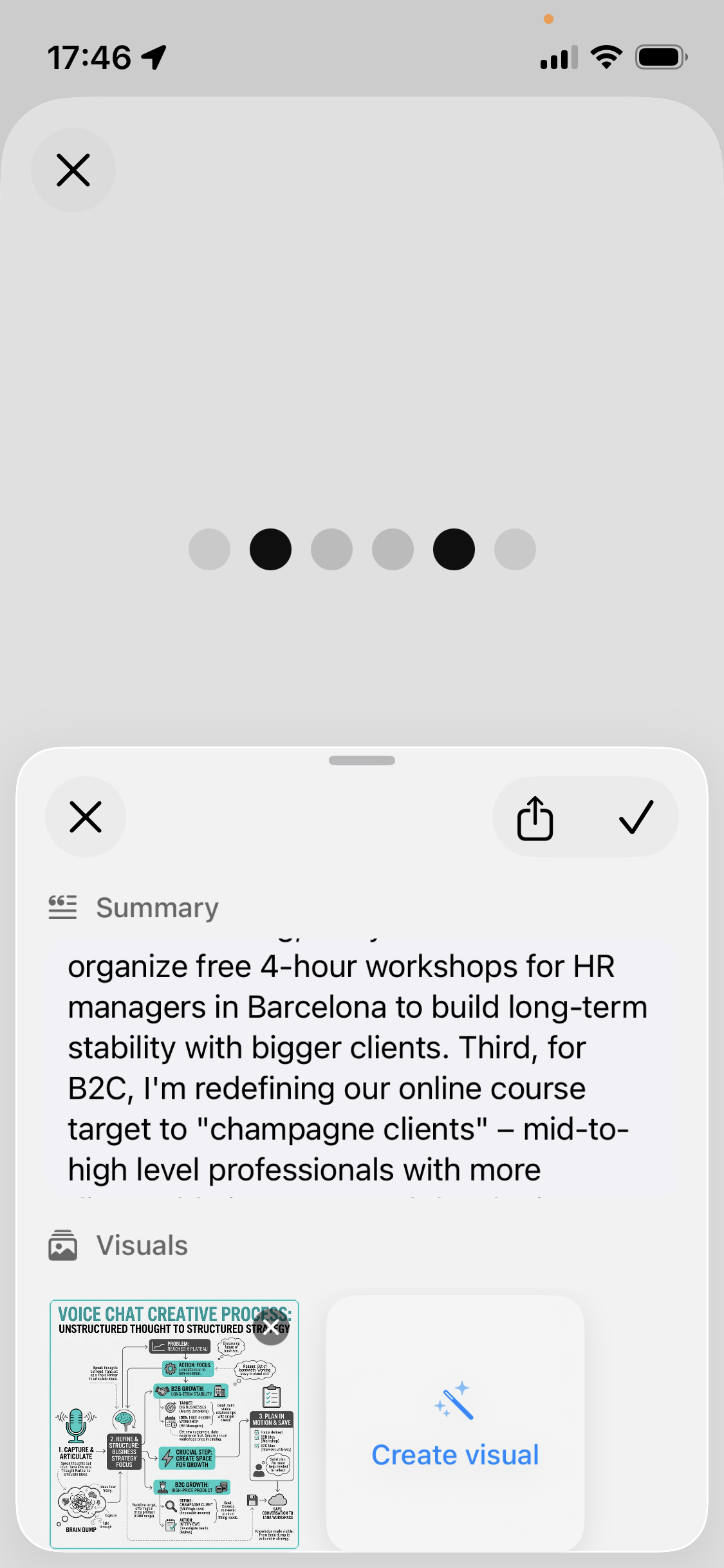
    Second, the summary at the end. After the conversation, I get a concise overview of what we discussed. This is surprisingly valuable. It’s one thing to have a conversation; it’s another to see the key points distilled afterward. It helps me understand what I actually figured out.

    Third, the visual outputs. I can quickly generate flowcharts or sketches based on our discussion. This isn’t just a nice-to-have. Seeing ideas in visual form often reveals gaps or connections that weren’t obvious when they were just words.

    What this means for how I work

    I’ve used plenty of AI tools. Most of them are about output: write this email, summarize this document, generate this image. They’re useful, but they’re transactional.

    This feels different. It’s not about getting something done; it’s about thinking better. The tool isn’t replacing my thinking; it’s scaffolding it. It’s giving me a structure to develop ideas I couldn’t have developed as well on my own.

    I’m sure I’ll be using this more often. Not for everything, but for the moments when I need to work through something complex or when I’m stuck and need a different angle.

    If you’ve ever wished you had someone to talk through an idea with, but didn’t want to bother an actual person at 11 PM on a Tuesday, this might be worth trying.

    What’s your experience with AI thinking partners? Have you found something that helps you think, not just produce?

    A mobile screen displays an app interface with a summary of professional tasks and a small visual representation of a business plan below.

    → 7:27 PM, Jan 9
  • Finished reading: Click by Jake Knapp 📚

    How do you know if what you’re building is actually what people want? Most teams skip this question and jump straight into execution.

    “Click” by Jake Knapp and John Zeratsky (the prequel to Sprint) offers a practical answer: the Foundation Sprint, a two-day process to develop your product hypothesis before you build anything. It focuses on understanding customer needs, leveraging your team’s strengths, and differentiating from competitors.

    I’m planning to use some of their tools when we define our next product. Not following the method 100%, but cherry-picking what makes sense for us.

    Have you read it? What’s your approach to validating ideas before building?

    → 9:13 PM, Jan 8
  • Mobile notifications cause significant distraction and performance reduction due to prolonged mind-wandering

    Mobile phones are a major source of distraction in our daily lives, even when we are not actively using them. Research shows that just a notification, a beep, or a vibration significantly disrupts our performance on tasks that require concentration. Remarkably, this disruption is as great as when someone is actually on a call or texting. You don’t even need to look at your phone to get distracted; that little sound or vibration is enough to lose your focus.

    The reason these short notifications have such a big impact lies in what happens in our minds afterward. A notification triggers a series of thoughts unrelated to what you are doing. You start to wonder who sent a message, what’s in it, if it’s important… in short, your thoughts wander. This phenomenon, also known as ‘mind wandering’, lasts much longer than the notification itself. Even after the sound is gone, those thoughts linger in your head, and your performance continues to decline.

    This explains why distraction by your phone is so persistent: it’s not just about the time spent checking your phone, but mainly about the mental interruption that lasts much longer. Our limited attention capacity must be divided over multiple things simultaneously, and when a part of it is consumed by thoughts about that notification, less is left for the task that requires our full attention.

    Related:

    • Attempting to do two or more attention-demanding tasks simultaneously reduces productivity
    • Avoid excessive task switching to increase efficiency
    • We pick up our phones over 350 times per day, almost four times more than in 2019
    → 9:47 PM, Jan 7
  • Finished reading: Piensa claro by Kiko Llaneras 📚

    I thought interpreting data wasn’t that hard. I know the basic rule: correlation doesn’t imply causation. But Kiko Llaneras’s book has made it clear that my biases go way beyond what I thought.

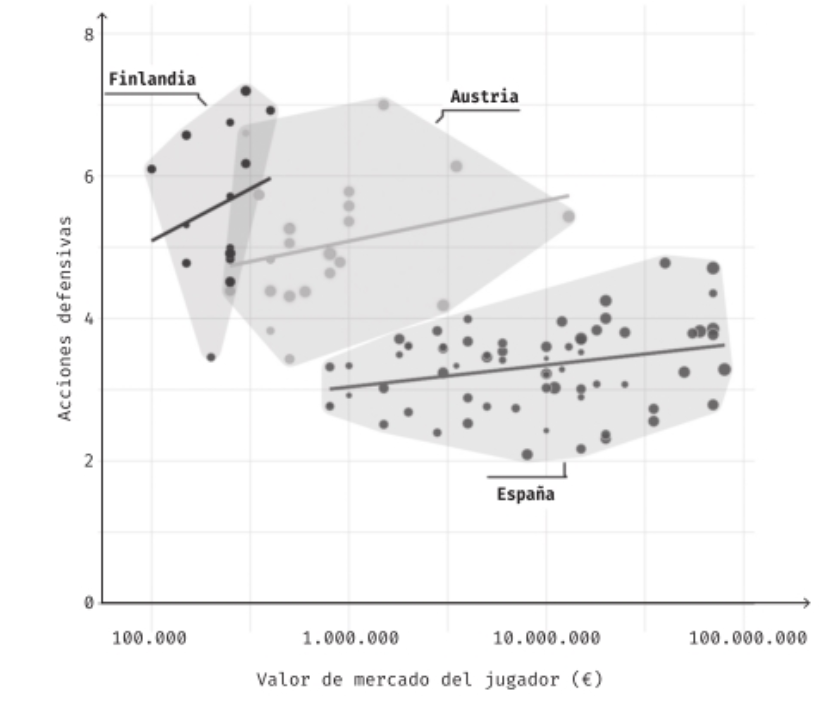
    The example that blew my mind: a graph showed a negative relationship between a football player’s value and their defensive actions. Until it was split by country. Suddenly, each country showed a positive relationship. The same data, two completely opposite stories depending on how you look at it. If this can happen with something as measurable as football, how many times do we misinterpret data in our daily lives without even realizing it?

    → 6:05 PM, Jan 7
  • If you’ve been following along, you’ve probably noticed I share updates when I start and finish reading books. It’s my way of keeping track and letting you see what’s on my reading list (you can also check my now page for the current lineup).

    But here’s the thing: announcing that I finished a book isn’t particularly interesting on its own. The finish line matters less than what I found along the way.

    So I’m making a small change. When I start a book, I’ll keep doing what I’ve been doing: a quick note to mark the beginning. But when I finish one? I’m committing to share at least a paragraph about it. Something useful. A thought that stuck, a concept worth passing along, or why it mattered (or didn’t).

    I’ve actually finished a few books recently and held off posting about them because I wanted to make this commitment first. So the next few posts you see will be those finish notifications, with a bit more substance.

    Let’s see if this makes the reading updates a little more useful.

    → 2:30 PM, Jan 7
  • Currently reading: The 3 Alarms by Eric Partaker 📚

    → 11:52 PM, Jan 6
  • Currently reading: Click by Jake Knapp 📚

    → 8:59 PM, Jan 1
← Newer Posts Page 2 of 2
  • RSS
  • JSON Feed
  • Micro.blog